
ST MARYS CHURCH, Hawkesbury, South Gloucestershire.
Gloucestershire is widely recognised for its share of beautiful and historic churches, ranging from the grand and lavish ‘Wool Churches’ in market towns of the Cotswolds to smaller chapels in its smaller rural villages.
It’s always a delight exploring a local church that you haven’t yet visited, and on a recent trip to the small hamlet of Hawkesbury in South Gloucestershire, I couldn’t pass up the chance to look at the Grade I listed Church of St. Mary the Virgin.’
The Church, surrounded by beautiful clipped yew trees, lies in a picturesque valley at the bottom of a steep knoll, west of the neighbouring village of ‘Hawkesbury Upton’.
A place of worship has stood here in the community since the Saxon period. The current structure dates mainly to the 11th and 12th centuries, and, like many churches of that era, it underwent changes in the 13th century with the construction of its tower, and further developments in the 14th and 15th centuries, including the Arcade and South aisle. With reconstruction work on the Church during the 19th century, the church has continued to grow and has really stood the test of time.
The impressive six-stage west tower of the church is perhaps the first thing that strikes you when visiting. Although not accessible to visitors, the tower, made of Cotswold stone, houses a 14th-century bell and a medieval bell frame that is still in excellent condition and among the best preserved in the country.
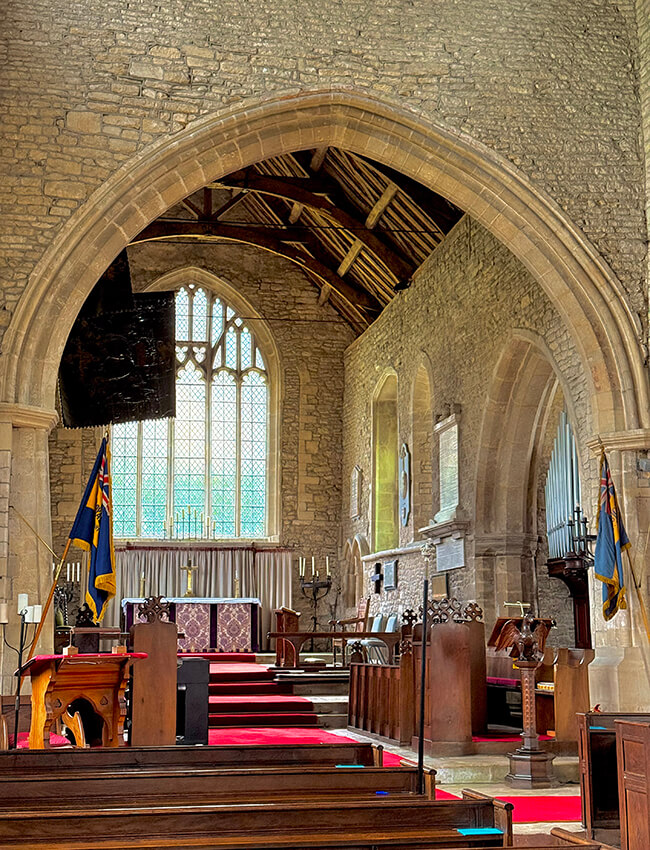
The interior of the church is just as charming and impressive as its exterior.
From its 15th-century stone pulpit to its baptismal fonts, one of which dates to the Norman period, the church is full of little gems waiting to be discovered!
The two newly restored heraldic banners hanging in St Mary’s Church bear the arms of Robert Banks Jenkinson (1770-1828), 2nd Earl of Liverpool, and the third-longest-serving British Prime Minister. His memorial, along with those of other members of the Jenkinson family, can be found within the Church.
Windows near the church entrance feature some reformed fragments of medieval stained glass. Although the fragments are from a variety of different window designs, you can only imagine how impressive the original stained glass windows would have been.
There is also a set of three stained glass windows dedicated to St Wulfstan. Wulfstan plays an important part in St Mary’s history. He served as a priest in the original Saxon church at Hawkesbury, and it’s said that it was here, whilst at prayers, that he became distracted by the smell of a goose cooking in a nearby kitchen. Mortified by this lapse in devotion to his prayers, he promised never to touch meat again and became a vegetarian! This can be seen in the stained-glass designs!
Wulfstan was revered by many and was one of only three Saxon bishops to remain in office after the Norman conquest of 1066. He died in 1095 as Bishop of Worcester and was later canonised by Pope Innocent III in 1203.
The Church of St Mary is steeped in history, and, as with any church, it is the amalgamation of these historical events and continuing traditions that bring the Church to life. A beautiful parish church in a tranquil setting that is definitely worth exploring.
By Richard Caddick (West Country Guy 2024)